
- What is electricity?
- What is a circuit?
- Electricity flows through wires
- Conductors and Insulators
- How is electricity generated?
- Static electricity
- Current electricity
- Staying safe using electricity


What is electricity? 

When you’re in the dark and you want to see You need, uh . . . electricity, electricity
Electricity is the flow of electrons. An electron is one of three main particles that make up an atom. You may remember that protons and neutrons were found in the nucleus of the atom while the tiny electrons are found in clouds around the nucleus.


Sometimes, electrons have the ability to move from atom to atom. This flow of energy is typically referred to as current.
This movement of electrons can do WORK when we put a load in its way. A load would be something like a light bulb or a motor. Electrons flow through the load like water running over a water wheel at an old mill. The water does work inside the mill while electrons can turn on the light or spin a motor.

What is a circuit?

Flip that switch and what do you get? You get, uh . . . electricity, electricity
Every room can now be lit With just, uh . . . electricity, electricity
Electrons are negatively charged. As a result they are attracted to places that are more positive. They are repelled when they are approached by other negative charges.


To help drive home this point of “opposites attract”, play a few rounds of Electric Field Hockey. Use positive and negative charges to move the puck around barriers and into the goal. Can you conquer level 3 in the FEWEST red or blue pucks?
Electrons need a pathway of wire to get to this more positive place. That pathway is called a circuit. A circuit MUST allow electrons to make the trip from the negative pole of a battery to the positive pole.
If an electron CAN follow the circuit from the battery, through a load (like a light bulb or a motor), and then back to the battery, then the circuit is called CLOSED. If there is any gap in the pathway, the circuit is OPEN. We use a switch to open and close circuits to turn ON and OFF the flow of electrons. It’s like cars on the road leading up to a drawbridge. When the bridge is up, the cars stop moving. Only when the circuit is closed can the flow begin again.

LAB: Use the Build a Circuit PhET to investigate circuits. You can build a circuit with in switches, batteries, wires, lights, and a few other surprises.

- For each circuit you build, do the following and document what happened:
- disconnect a light
- add another light
- add another battery
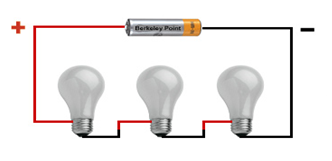
Build a SERIES circuit. The picture shows a circuit with ONE pathway from the battery and then to the battery. The electrons must do work on each of light bulbs to get to the positive portion of the battery.


A series circuit reminds me of a baseball diamond. All of the bases must be touched when you hit a homerun. There is only one path back to home plate. If you skip a base, you are OUT!
Turn all of the lights on and then disconnect one of the bulbs. What happened to the entire circuit? Add another light. What happens to the brightness of the bulbs? Add another battery to the circuit. What happens?

Now build a PARALLEL circuit like the one pictured. Notice that each light has a separate pathway to and from the battery.
Disconnect a bulb. Add a bulb. Add a battery. Add switches. What happens to the brightness of each bulb when you do these things?

What are the pros and cons of each circuit type? Why are series often used in Christmas lights while a parallel circuit is used in a home or school?

A “short circuit” occurs when electrons find a shorter pathway back to the battery than going through the loads. This path of least resistance will often get extremely hot because a huge flow of electrons will be passing through. We can see this by touching a 9 Volt battery to a sample of steel wool. The thin strands of Iron heat up to the point of catching fire.
Electrons travel through metal wires 

Where do you think it all comes from This powerful . . . electricity, electricity
Through high wires to here it comes. They’re bringing, … electricity, electricity

Every building must be wired to use it Uh . . . electricity, electricity
A wire is simply a highly conductive material that allows electrons to travel from the source, to the loads, and then back to the source. All wires have some resistance to the flow of electrons. This resistance to flow is measured in OHMS. There are THREE big factors that make wires more efficient for the flow of electrons. More efficient = fewer Ohms of resistance.

Electrons move faster in SHORT wires compared to LONG wires. Imagine that the wire is like an obstacle course for electrons. A longer obstacle course will slow down the electrons.

Electrons move faster in THICK wires (low gauge) compared to THIN wires. A 10 lane superhighway is easier to travel down than a 2 lane gravel road. Less friction gives us more efficient electrons.

Electrons move faster in COLD wires compared to HOT wires. When particles are closer together the charges can jump quicker.
Conductors and Insulators

Over on the Heat Energy page we discussed a topic called specific heat. It’s the idea that not every material heats up at the same rate. This concept can apply to electricity as well. Some substances allow electrons to flow quickly through them. These are called CONDUCTORS. Other materials slow down or even stop the flow of electrons. These are called INSULATORS.
Metals are typically good conductors. Copper, Mercury, and Silver are just a few of the many metals that conduct electricity.


Rubber, plastics, some fabrics, and even air can make a good insulator (poor conductor).

How is electricity generated?

A generator is a machine that contains a powerful magnet that creates a magnetic field. When wires are rotated rapidly through this field, then a current of electricity is produced.

Turn that generator by any means. You’re making, uh . . . electricity, electricity!
The magic of a coil of Copper wire and a magnet
When a magnet is moved next to a coil of Copper wire (or when the Copper is moved past a magnet) it causes the electrons in the Copper to move. This motion of electrons can be measured using a Voltmeter. Watch as we drop a magnet through a coil of wire called a solenoid. The tiniest of Volts can be read on the meter.


Now if we can invent a way to continuously make a magnet move through a coil of Copper wire. This handheld electric generator has a metal cylinder in the center. Within that cylinder, a magnet is moving near a coil of Copper wire. As long as the user turns the crank, electricity is generated.
This flashlight never needs a battery. All you need to do is shake the magnet back and forth through the coil of Copper wire. This pushes electrons to a capacitor to use when the switch is pushed “on”.

The magic of electricity in a coil of Copper wire
Now we know how electricity is generated but the magic doesn’t stop there. If we send electricity through a coil of Copper wire it generates a magnetic field. I’ll use a compass to prove this.


That magnetic field can then be used to turn a magnet. We can make the magnet start spinning within that field by turning on and off the electric flow (or in this case, constantly reversing the flow)A turning magnet in a magnetic field is the basic structure of an electric motor.
An electric generator and electric motor are almost exactly the same thing…just in reverse. Turning the magnet near a coil of Copper generated electricity but sending that electricity through the second device will cause the magnet inside to turn in the magnetic field. The generator can act as a motor and then back again.

Generating power for us to use

Now, if we only had a superhero who could stand here and turn the generator real fast, then we wouldn’t need to burn so much fuel to make . . . electricity, electricity

Power plants most all use fire to make it Uh . . . electricity, electricity Burning fuel and using steam, they generate electricity, electricity!

There are several ways to TRANSFORM energy into the electricity that we use. No energy transformation is 100% efficient. Every transformation of energy gives off some HEAT that cannot be used.
- burn fossil fuels like coal or natural gas to heat water into steam
- cause nuclear fission (or fusion) underwater to heat water into steam
- tap into the natural kinetic energy of wind or water
- convert the energy of a photon (light) into electricity
Use the interactive map on the Carbon Brief website to learn about the generators that power the United States. Each color represents a different source for the electrical power. Clicking on a State will highlight its individual sources. Compare the States and make some connections as to why they use what they do.

Static Electricity

Benjamin Franklin flying his kite was searching for… electricity, electricity
He knew that it had something to do with lightning. It’s all, uh… electricity, electricity

Rubbing a comb with wool or fur will give you a charge of electricity, (static) electricity Stroking a cat to make it purr, you’re building up static electricity, electricity

Electricity at rest is called STATIC electricity. Like in the winter, wearing a heavy coat, you get a shock off the doorknob or you scrape across a carpet and sneak up on your very best friend and zap him on the ear with a shock of… electricity, electricity

Use this PhET to investigate static charges. Rub charges off of the sweater and see what the balloon is attracted to. Charge up two balloons and investigate. Pay particular attention to the electrons in the wall when you bring a charged balloon closer to it. Why does a charged balloon “stick” to the wall?


Static electricity can be seen on a grand scale during a thunderstorm. When convection currents push warm, moist air high up into the sky, the charges in the atmosphere start to separate.
Negative charges tend to move to the bottom of the cloud while positive charges are often found at the top.


Now compare the static balloon to a thunderstorm coming over the city. The negative-charged bottom of the cloud tends to repel the negative charges of the ground deeper into the Earth. Electrons in taller objects would be repelled more. This exposes more positive charges at the surface. Once the negative and positive areas meet…KERBLAM!!! A lightning strike is a huge discharge of electrons to the ground below.
The Van de Graaff generator
Current Electricity

Current flowing to and fro, makes a circuit of… electricity, electricity
Electrical current is a measure of the number of electrons that flow. It is measured in Amperes or Amps for short. Many people hear the words “High Voltage” and think it is dangerous. While this may be true, it doesn’t have to be. High Amps, however, is deadly. Your human heart can only handle about 0.1 Amps before you get to dangerous levels of electricity.


An AMPERE (Amps) is a measurement of electrical current. Imagine that you were the size of Ant-Man and could count the number of electrons that passed by you in a second. ONE Amp of electricity would be recorded if about 6.25 X10¹⁸ electrons went speeding by!

Voltage is the pressure that makes it go. It’s pushing, uh… electricity, electricity
Voltage is referred as electrical pressure. In order to understand better, let’s make a comparison to water. Water needs a push to get out of a garden or fire hose. Likewise, electrons need a similar push to move down a wire. The amount of this push is called voltage.

Voltage is also referred to as electrical potential. Water flows downhill. A slow moving stream is fairly flat and as a result has very little motion. Water over Dragon Falls in Venezuela has 979 meters to fall. That is a great deal of potential energy and as a result has a great “desire” to fall.

Just like water flows downhill, electrons may be led to move from one metal to another within a battery. Some will have a small difference in potentials like a AA (1.5 Volts) while others will push the electrons with more energy like a car battery (12V)


“WAIT A SECOND! I see the Van deGraaff generator listed there at 500,000 VOLTS! That can’t be correct, CAN IT?! The answer is yes. The electrons that are moving due to the charges on the large metal dome are really anxious to flow. 500,000 Volts is quite possible. That said, the Amperage is extremely low. It could be measured in the thousandths of an Amp. That means that the actual number of highly energized electrons is very low. The device is safe to use.

Watts will tell you just how much you’ll be using Uh . . . electricity, electricity
Watts is a measure of POWER. Power tells us how much work is being done in a specific amount of time. Getting the same amount of work done in less time (producing light in this case) will increase the power.
Staying safe using electricity

Powerful stuff, so watch that plug! It’s potent… electricity, electricity
Obviously, we don’t stick objects into the outlets or light sockets. Wear insulated gloves and boots when handling live electricity.

This teenager was struck by lightning. You can see that the electricity followed the path of her corded headphones and burned the cord down to her ipod. Her device acted like a lightning rod and pulled the electrons around her body instead of through. Very lucky indeed.
How might you avoid the situation entirely? Seek shelter. Heading indoors is the best option. The tallest tree in a park is not shelter. It is the best lightning rod around. If shelter is not an option, make yourself as low to the ground as possible.


Plugging too many outlets into the same plug will cause overheating and could easily blow a circuit or start a fire.
The ions that are in water allow electricity to flow through it really well. Being IN or NEAR water during a thunderstorm is not wise. Allowing corded electricity to be near water is also unwise. You won’t get a warning if something you are doing is unsafe, electricity will simply shock you. Changing a car battery in the rain while standing in pools of water. Placing electrical outlets near a sink without the appropriate GFI (Ground Fault Interrupter) is dangerous and is not “to code”. It would need to be fixed before trying to sell the home.

Maintaining high Voltage power lines requires a command of electricity. To stay safe, you MUST know what you can and cannot do at all times. “It’s not a job for hot dogs”.